
 |
|
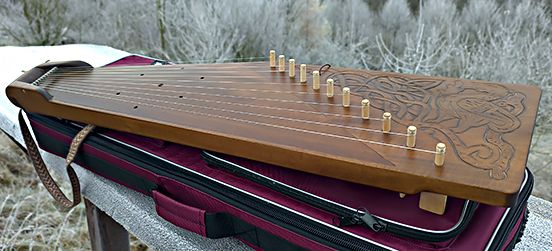
11-stringed wing-shaped gusli
$465
(available, you can take it right now)
(gusli+strap+softcase+lessons)
Contact the maker and buy the instrument
|
|
Wing-shaped gusli [gusli with a wing element] is one of the most common types of traditional gusli in Latvia and Russia, can be found in Estonia,
and it is also the only traditional type of gusli in Belarus. Although the tradition of playing the gusli in Belarus was interrupted,
the instruments played by Belarusians can be found in museums and essays by ethnographers from early 20th century.
Body: linden.
Linden and oak are the most ancient and legendary kinds of wood for gusli making. Gusli made from linden are repeatedly mentioned in Baltic dainas (traditional old songs). Sometimes linden is mentioned as a parralel to the feminine and oak to the masculine.
There are archeological gusli finds from linden as well. The linden wood is a medium-hard one (as well as the alder, the aspen, etc). Therefore you can expect well-ballanced frequencies in a linden gusli sound. These instruments are not heavy, wooden grain is mostly homogeneous.
Coating: wood stain and waxing.
|
 |
|
 |
|
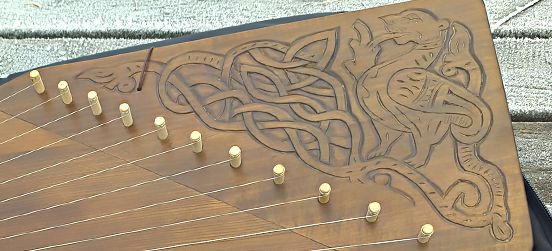
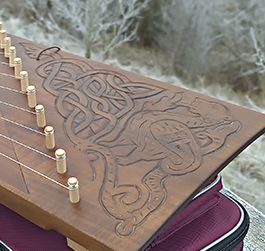
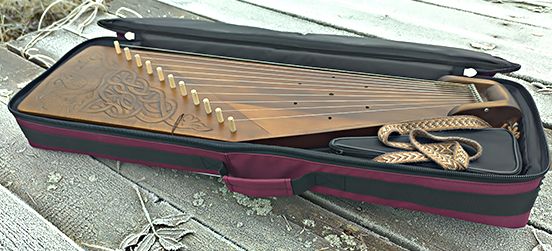
The wing of the gusli is decorated with carvings based on a medieval picture from Eastern Europe and a pattern typical for medieval gusli.
Soundboard: spruce.
Spruce is the most traditional wood for soundboards.
The correct selection of musical qualities of a specific spruce soundboard
as well as an adherence to technology when glued — allows the instrument to expand timbre,
adds warmth to the sound. Also the loudness of the instrument directly depends on a good soundboard.
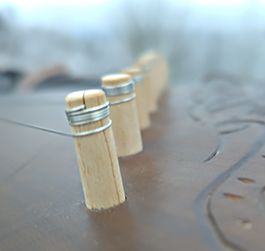
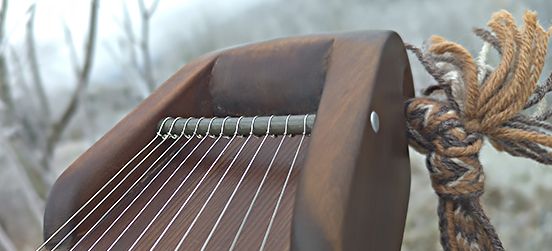
Pegs: maple.
Maple — is interesting as a material for the pegs, as its wood-fibres are not accentuated. The maple wood is a hard one, but at the same time its surface is soft enough for the pegs to be perfectly adjusted to the cone-shaped peg hole, to spin smoothly and to hold the pitch perfectly.
|
|
 |
|
 |
|
 |
|
 |
|
Strings: plain steel strings, light tension.
Metal strings could have been already installed on the gusli of the 11th century,
and are most satisfying for a modern musician.
The range of ticknesses of the strings is between 0.021" and 0.011". The higher tension of the strings — the louder the instrument.
The lighter tension — the more overtones in the sound of each string, the richer the sounds of the gusli. Of course, everything
has its reasonable limit: too much tensed strings are often break (or deform the instrument), and too slightly tensed are not
perfectly in tune. This variant is the optimal for this gusli type, according to its construction and playing techniques.
Softcase:
There is the framed bag case in the set. Outer layer is from the waterproof bag fabric.
All the sides are laid with two layers of foam and a layer of hard plastic.
It is the best comprehensive protection for the instrument from water, drops and shocks.
There are comfortable shoulder straps for carrying, soft carry handles for horizontal and vertival carrying.
Two outside A4 pockets, one inside pocket for small items.
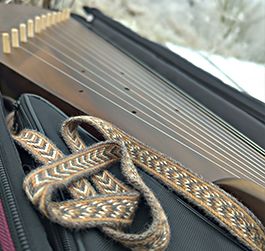
A woven strap for playing in a standing position:
A traditional kind of a handmade woven belt.
|
 |
|
Contact the maker and buy this instrument |
|
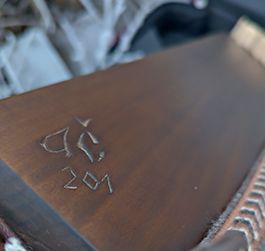
Alieś Čumakoŭ (Ales Chumakou/Aliaksandr Chumakou). Minsk. 2025.
|


